
Organisateur de mariages
Study Duration:
3 Months Platform Access
30 hours + 1 Assignment (3,000 words)
Certifications
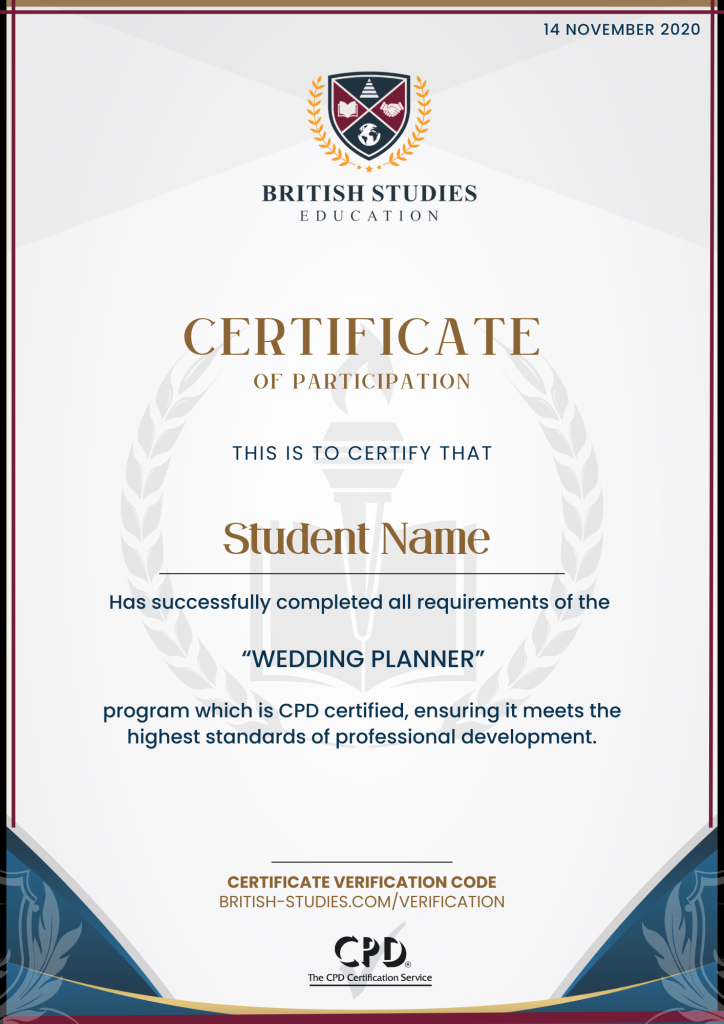
Études britanniques CPD Diploma
Limited Time Tuition Fees
3 monthly payments: €70 / month (Total €210)
One-time payment: €145 (Save €65)


WEDDING & EVENT PLANNER
Plan the details. Create the experience. Make the moment unforgettable.
Welcome to Wedding and Event Planning—where passion, precision, and unforgettable celebrations come together! Behind every breathtaking wedding, seamless corporate gala, or unforgettable milestone party is a mastermind who turns chaos into magic. Event planning isn’t just about picking out gorgeous color palettes or arranging stunning floral displays; it is about crafting life-changing moments and bringing a client’s biggest dreams to life while keeping every single detail running smoothly behind the scenes.

In this course, we are pulling back the curtain and giving you the exact blueprint to thrive in this high-energy, fast-growing industry. Whether you dream of launching your own boutique planning agency or landing a high-demand role in event management, you will gain the exact tools, confidence, and real-world skills to execute flawlessly from day one.
Throughout our modules, you will master every core pillar of the industry, starting with translating a client’s vision into clear concept boards and spatial layouts. From there, you will learn to build bulletproof master timelines, manage vendor logistics, navigate budgets without sacrificing quality, and handle last-minute hiccups with total poise and professionalism. Beyond the execution of the event itself, you will also gain actionable business strategies for client consultations, winning proposal pitches, social media branding, and pricing your services for real profit.

If you love organization, get energized by creative projects, and thrive on bringing people together for incredible experiences, you are in the right place. Get ready to turn your passion into a powerful, rewarding career—let’s dive in and start planning!
The sections include the following:
Module Overview
Wedding and event planning is much more than choosing beautiful decorations or creating an attractive programme. At its heart, event planning is the process of transforming an idea into a carefully organised experience.
An event planner works behind the scenes to make sure that people, suppliers, schedules, budgets, venues, and creative details work together. From the first client consultation to the final guest departure, the planner is responsible for keeping the event moving in the right direction.
A successful event may look effortless to guests, but that sense of ease is usually the result of extensive preparation.
What Does an Event Planner Actually Do?
An event planner may be responsible for developing the event concept, preparing budgets, finding suppliers, communicating with the client, negotiating with vendors, preparing schedules, coordinating logistics, managing guests, supervising setup, and responding to unexpected situations.
The role requires both creative thinking and operational discipline. A planner might spend one hour discussing floral arrangements and the next solving a transportation problem.
This variety is one of the most exciting aspects of the profession.
Planner, Coordinator, or Event Manager?
Although these terms are sometimes used interchangeably, they can describe different responsibilities.
A planner may become involved months before the event and help develop the entire celebration. A coordinator often focuses on making sure the established plan is executed smoothly. An event manager may oversee larger teams, operations, budgets, and multiple aspects of an event.
In smaller businesses, one professional may perform all three functions.
The Professional Planner’s Mindset
The best planners understand that their job is not simply to make an event look good. Their job is to make the experience work.
A professional planner constantly thinks ahead:
What could go wrong?
What does the client need next?
What information does the supplier need?
What will the guest experience be like?
Key Takeaway
Great event planning combines creativity, organisation, communication, anticipation, and calm decision-making.
Module Overview
Most clients do not arrive with a fully developed event plan. They usually have ideas, preferences, photographs, colours, Pinterest boards, family traditions, or a general feeling they want to create.
Your role is to transform those ideas into a clear event concept.
Understanding the Client’s Vision
Imagine a client says:
“I want an elegant wedding, but I don’t want it to feel too formal.”
That sentence contains an important creative direction. The planner must determine what “elegant” means to that particular client.
Perhaps they imagine soft lighting, refined table settings, neutral colours, sophisticated floral arrangements, and relaxed entertainment.
The planner’s responsibility is to ask questions until the vague idea becomes something tangible.
Theme vs. Concept
A theme is often a broad idea, such as:
Garden Wedding
A concept provides more detail:
An intimate evening garden celebration featuring soft botanical colours, warm candlelight, seasonal flowers, natural textures, and long communal tables.
The concept gives suppliers something practical to work with.
Creating a Cohesive Event
Every major visual decision should support the same story.
The invitations, flowers, tables, signage, lighting, furniture, and even music should feel as though they belong to the same event.
Working Within Reality
Creativity must always be balanced with the client’s budget, venue, guest count, availability, and practical limitations.
The strongest planner is not the person who says “yes” to everything.
It is the person who can say:
“Here’s how we can achieve the feeling you want within your budget.”
Key Takeaway
A successful event concept transforms a client’s imagination into a clear, practical, and cohesive experience.
Module Overview
The first consultation is where the professional relationship begins. It is an opportunity to understand the client, establish expectations, identify priorities, and determine whether your services are the right fit.
A good consultation should feel like a conversation—not an interrogation.
Start With Listening
Instead of immediately presenting packages and prices, invite the client to describe their event.
Ask:
“What would make this event feel perfect to you?”
The answer may reveal their priorities more clearly than a checklist.
One client may care most about food. Another may prioritise photography. Another may simply want their guests to feel comfortable.
Questions That Matter
A thorough consultation should cover:
Event date
Type of event
Guest count
Location
Budget
Theme or style
Priorities
Suppliers already booked
Cultural or religious requirements
Special guests
Accessibility requirements
Desired level of planner involvement
Managing Expectations
A common source of event problems is unclear expectations.
If your package includes event-day coordination but not complete vendor sourcing, the client should know this before signing.
Clear expectations create better working relationships.
Recording the Conversation
Take organised notes and document important decisions.
A professional consultation record can later become the foundation for your event proposal, contract, budget, and planning checklist.
Key Takeaway
The first consultation is not simply about selling your service—it is about understanding the client well enough to plan the right event.
Module Overview
There is no universal “ideal client.” Every person communicates differently, makes decisions differently, and responds to pressure differently.
A skilled planner learns to adapt without compromising professionalism.
Different Client Personalities
Some clients are highly organised and want to approve every detail. Others prefer to delegate almost everything.
Some want frequent updates. Others prefer one structured update each week.
Neither approach is automatically wrong. The planner’s responsibility is to establish a communication system that works.
Working With Indecisive Clients
Indecision can slow an event down.
Instead of overwhelming the client with ten options, narrow the choices.
For example:
“Based on your budget and style, I recommend these two options. Option A provides a more intimate atmosphere, while Option B gives you more space for entertainment.”
This makes decision-making easier.
Managing Difficult Conversations
If a client is unhappy, do not immediately become defensive.
First listen.
Then clarify what happened, acknowledge the concern, explain what can be done, and agree on the next step.
Family Involvement
Weddings often involve several people with different opinions.
The planner must respect family members while keeping the agreed client priorities at the centre of decision-making.
Key Takeaway
Understanding people is just as important as understanding event logistics.
Les cours étant dispensés en ligne dans le cadre de la formation à distance, les étudiants ont la possibilité de se consacrer davantage à leurs études et de valider le programme plus rapidement. Tout dépend de l'emploi du temps et des obligations de chacun. Plus les étudiants peuvent consacrer d'heures à leurs études, plus vite ils peuvent valider le cursus.
Module Overview
Once the client’s vision is clear, the next step is turning that vision into an organised plan.
Planning creates structure. Without structure, even a creative event can quickly become chaotic.
Define the Event
Start by documenting the fundamentals:
What is the event?
Why is it being held?
When will it happen?
Where will it happen?
Who will attend?
What is the budget?
What experience should guests have?
These questions establish the foundation for every later decision.
Set Priorities
Not everything can be equally important.
A useful approach is to divide requirements into:
Must Have — essential to the event
Important — valuable but flexible
Nice to Have — included if budget and time allow
This helps when compromises become necessary.
Create Milestones
Instead of looking at the entire planning process as one huge task, divide it into stages.
For example:
Planning Stage → Supplier Stage → Guest Stage → Final Preparation → Event Day → Post-Event
Track Responsibilities
Every task needs an owner.
A simple planning spreadsheet can include:
Task | Responsible Person | Deadline | Status |
Book photographer | Planner | May 10 | Pending |
Finalise menu | Client/Caterer | May 15 | In Progress |
Confirm guest count | Client | June 1 | Pending |
Key Takeaway
Good planning turns hundreds of small details into a manageable system.
Module Overview
A wedding is a long-term project made up of many smaller decisions. Understanding the complete journey allows planners to anticipate what needs to happen next.
Stage 1: Discovery
Understand the couple, their priorities, budget, guest count, and vision.
Stage 2: Foundation
Establish the date, venue, budget, and major suppliers.
Stage 3: Development
Develop styling, guest management, catering, entertainment, photography, transportation, and ceremony details.
Stage 4: Finalisation
Confirm all suppliers, payments, guest numbers, schedules, floor plans, and special requirements.
Stage 5: Execution
On the wedding day, the planner moves from project manager to event coordinator.
Stage 6: Follow-Up
After the event, confirm that suppliers have completed their responsibilities, outstanding payments are handled, personal items are returned, and the client receives appropriate follow-up.
Key Takeaway
Wedding planning is a journey, not a single task. Each stage prepares the event for the next.
Module Overview
The venue is one of the biggest decisions in event planning because it affects the guest experience, budget, layout, suppliers, transportation, styling, and schedule.
Look Beyond Appearance
A beautiful venue may not necessarily be a practical venue.
Ask:
Does it accommodate the expected guest count?
Is there sufficient parking?
Is it accessible?
Are there noise restrictions?
What suppliers are permitted?
How much setup time is available?
Is there a backup location?
Understanding Capacity
A venue’s advertised capacity may not tell the whole story.
A room that accommodates 150 people for a standing cocktail event may accommodate fewer guests once tables, chairs, a stage, dance floor, buffet, and service areas are included.
Conducting a Site Visit
Walk through the venue as if you were a guest.
Where will people enter?
Where will they go?
Where will they wait?
Where will suppliers unload?
Where will the couple take photographs?
These questions reveal practical issues that photographs cannot.
Key Takeaway
The right venue is not simply the one that looks beautiful—it is the one that supports the entire event.
Module Overview
Budgeting is one of the most important responsibilities of a planner. Clients want their event to feel special, but they also need financial control.
Your role is to help them understand what their money can realistically achieve.
Building the Budget
Common categories include:
Venue
Catering
Décor
Flowers
Photography
Videography
Entertainment
Invitations
Transportation
Staffing
Accommodation
Miscellaneous expenses
Prioritising Spending
Suppose a client has a $20,000 budget.
If photography is extremely important to them, you may recommend allocating more toward photography while reducing spending in areas they consider less important.
Budgeting should reflect values, not just percentages.
Hidden Costs
Some expenses are easily overlooked:
Delivery fees
Overtime
Setup charges
Service charges
Taxes
Transportation
Additional staffing
Equipment rental
Contingency
Unexpected costs are part of real event planning.
A contingency allowance gives the planner room to respond without immediately disrupting the entire budget.
Key Takeaway
A budget is not a restriction on creativity. It is a tool for making creativity achievable.
Module Overview
Professional event planning requires clear documentation. Contracts protect expectations by establishing what has been agreed upon.
Understanding Scope
A contract should clearly explain the services being provided.
For example:
“Full Wedding Planning includes supplier coordination, budget management, event timeline development, venue coordination, and event-day management.”
The client should understand exactly what they are purchasing.
Payment Structure
Clearly document:
Initial deposit
Payment milestones
Final balance
Payment methods
Due dates
Cancellation and Rescheduling
Events sometimes need to be postponed or cancelled.
Clients should understand the applicable terms before committing.
Why Documentation Matters
A written agreement reduces misunderstandings.
After a verbal conversation, important decisions should be documented through email, a planning system, or another appropriate record.
Key Takeaway
Clear documentation protects relationships because everyone knows what was agreed upon.
Module Overview
Your suppliers can determine whether an event runs smoothly.
A reliable caterer, photographer, florist, decorator, DJ, and transportation provider can make your job significantly easier.
Finding Suppliers
Sources may include:
Professional networks
Referrals
Industry directories
Social media
Previous events
Venue recommendations
Evaluating Suppliers
Do not evaluate suppliers on price alone.
Consider their:
Experience
Quality
Reliability
Communication
Reviews
Availability
Professionalism
Contract terms
Supplier Communication
A supplier should receive the information they need to succeed.
Provide the event date, venue, arrival time, responsibilities, contact details, setup requirements, and relevant restrictions.
Building Relationships
Treat suppliers professionally even when you are negotiating.
Good supplier relationships can lead to better communication, referrals, and long-term collaboration.
Key Takeaway
Your supplier network is part of your professional reputation. Choose partners carefully.
Module Overview
Styling is where creative ideas become visible.
It includes everything from flowers and furniture to table settings, lighting, signage, fabrics, and decorative details.
Creating Visual Harmony
A successful event does not require every detail to match perfectly. Instead, the elements should complement one another.
For example, a romantic evening wedding might combine:
Warm lighting
Soft florals
Neutral colours
Elegant stationery
Textured linens
Candlelight
Colour Selection
Choose a palette that works with the venue and overall atmosphere.
Consider how colours appear under natural and artificial lighting.
Styling With Purpose
Every decorative decision should have a reason.
Ask:
Does this detail improve the atmosphere, guest experience, or visual story?
If not, it may not deserve part of the budget.
Key Takeaway
Good styling is not about adding more—it is about choosing the right details.
Module Overview
An event is experienced, not simply observed.
Guests may forget the exact colour of the napkins, but they are likely to remember whether they felt welcomed, comfortable, entertained, and included.
The Guest Journey
Think about the event from the guest’s perspective:
Before arrival → Arrival → Welcome → Ceremony → Transition → Reception → Departure
At every stage, ask what information or support the guest needs.
Comfort Matters
Consider:
Seating
Temperature
Restrooms
Accessibility
Food
Transportation
Signage
Waiting times
Personalisation
Personal touches make an event feel intentional.
A handwritten note, meaningful photograph, personalised menu, or family tradition can have more emotional impact than expensive décor.
Key Takeaway
The best events make guests feel considered.
Module Overview
Guest management is both an administrative task and an important part of the guest experience.
Accurate information helps the planner make decisions about seating, catering, transportation, and communication.
Invitation Planning
An invitation should clearly communicate:
Event name
Date
Time
Location
Dress code
RSVP instructions
Important additional information
RSVP Tracking
Use a central guest list to record responses.
Do not depend on memory or scattered messages.
Special Requirements
Track dietary restrictions, accessibility needs, children, plus-ones, and other relevant requirements.
Seating Plans
A seating plan should consider practical and interpersonal factors.
Place guests where they can comfortably participate in the event while considering relationships and accessibility.
Key Takeaway
Accurate guest information makes better event decisions possible.
Module Overview
Timing is the invisible structure of an event.
A good timeline allows everyone to know where they should be, what they should be doing, and when it needs to happen.
Start With Fixed Times
Begin with non-negotiable elements:
Venue access
Ceremony
Meal service
Venue closing
Transportation
Then build the remaining activities around these fixed points.
Allow Buffer Time
Real events rarely run perfectly to the minute.
Allow additional time for:
Guest movement
Photography
Delays
Setup
Transitions
Share the Timeline
The final timeline should be distributed to the relevant team members and suppliers.
Everyone should be working from the same information.
Key Takeaway
A good timeline creates structure while leaving enough flexibility for reality.
Module Overview
The ceremony often contains the most meaningful moments of the wedding. Coordination must therefore be detailed but discreet.
Processional
Confirm the order and timing of everyone entering the ceremony.
Ensure participants know where to wait before entering.
Music
Music cues should be clearly communicated to the DJ, musician, or sound technician.
Ceremony Participants
Confirm the responsibilities of the officiant, readers, musicians, wedding party, and other participants.
Rehearsal
A rehearsal helps everyone understand where to stand, when to move, and what to expect.
Transition
Plan what happens immediately after the ceremony.
Guests should never be left wondering where they should go next.
Key Takeaway
A well-coordinated ceremony feels natural because everyone behind the scenes knows exactly what to do.
Module Overview
The reception brings together food, entertainment, speeches, dancing, and social interaction. The planner’s job is to make the transition between these elements feel natural.
Designing the Flow
A typical reception may include:
Guest arrival
Grand entrance
Welcome
Meal
Speeches
Special dances
Entertainment
Cake cutting
Dancing
Closing
Not every wedding needs all these elements.
Coordinating Speakers
Speakers should understand when they are expected to speak and approximately how long they have.
Working With the Emcee
The emcee should receive the final programme and understand important announcements and transitions.
Keeping Energy Balanced
Long periods without activity can make guests disengage.
Similarly, too many activities can make the event feel rushed.
Key Takeaway
A great reception has rhythm: moments of excitement balanced with moments to relax and connect.
Module Overview
Food is one of the most memorable parts of an event, but catering also involves significant logistics.
Selecting a Service Style
Different formats create different experiences.
A plated dinner feels structured and formal. A buffet provides variety and flexibility. Food stations can encourage movement and interaction.
Menu Development
Consider:
Guest preferences
Event style
Budget
Season
Venue
Dietary requirements
Allergies and Restrictions
Never treat food allergies casually.
Relevant information should be clearly communicated to the catering team and handled according to appropriate food-safety practices.
Service Timing
Coordinate food service with speeches, entertainment, photographs, and other activities.
Key Takeaway
Catering is both a culinary decision and a logistical decision.
Module Overview
Entertainment shapes the emotional energy of an event.
The right music, performer, host, or activity can transform how guests experience the celebration.
Choosing Entertainment
Consider:
Audience
Event style
Venue
Budget
Duration
Technical requirements
Music Planning
Different moments require different energy.
Guests may want softer background music during dinner and more energetic music later in the evening.
Technical Coordination
Confirm sound equipment, microphones, lighting, staging, power requirements, and setup times.
Backup Planning
Technology can fail.
Have contingency options for important equipment or entertainment elements whenever practical.
Key Takeaway
Entertainment should support the story and atmosphere of the event—not simply fill empty time.
Module Overview
The event eventually ends, but photographs and videos allow clients to revisit the experience.
Coordinating the media team is therefore an important part of planning.
Choosing the Right Style
Photography styles may vary significantly.
Some clients prefer candid images, while others prefer traditional portraits or editorial-style photography.
Creating a Shot List
A shot list helps ensure important people and moments are captured.
Include:
Couple
Family
Wedding party
Important details
Ceremony
Reception
Special traditions
Protecting the Timeline
Photography should be built into the schedule.
If the couple needs 45 minutes for portraits, that time should be planned rather than taken unexpectedly from the reception.
Key Takeaway
Photography coordination is about protecting memories without disrupting the experience itself.
Module Overview
Logistics is the practical machinery behind the event.
When logistics are handled well, guests may never notice them. When logistics fail, they quickly become visible.
Setup
Create a detailed setup schedule showing who arrives, where equipment goes, and who supervises each area.
Deliveries
Coordinate delivery windows carefully.
Multiple suppliers arriving simultaneously can create congestion and confusion.
Equipment
Maintain an inventory of required equipment and identify who is responsible for each item.
Transportation
Consider transportation for:
Guests
Couple
VIPs
Suppliers
Equipment
Décor
Breakdown
Create a breakdown plan before the event begins.
Identify what needs to be removed, who collects it, and when the venue must be cleared.
Key Takeaway
Good logistics make complex events feel simple.
Module Overview
On event day, the planner becomes the central point of coordination.
You may have suppliers asking questions, guests needing assistance, clients requesting updates, and schedule changes happening simultaneously.
Team Briefing
Before the event begins, brief your team.
Explain:
Event objectives
Schedule
Responsibilities
Communication procedures
Emergency procedures
Delegation
Delegation is not losing control. It is how professionals maintain control.
Give specific responsibilities to specific people.
Clear Communication
Use direct instructions.
Instead of saying:
“Can somebody check if the flowers are ready?”
say:
“James, please confirm with the florist that the centrepieces are ready by 3:00 PM.”
Staying Calm
Your behaviour influences your team.
If you panic, the team may panic. If you remain focused, they are more likely to remain focused too.
Key Takeaway
Event coordination is leadership in motion.
Module Overview
Even the most detailed plan cannot eliminate uncertainty.
A professional planner therefore prepares not only for the expected but also for the possible.
Common Changes
Examples include:
Supplier delays
Weather changes
Guest cancellations
Missing equipment
Schedule changes
Unexpected guests
Technical problems
Assess Before Reacting
When something happens, ask:
What happened?
How serious is it?
Who is affected?
What options are available?
Who should be informed?
Solve Before Escalating
If a minor issue can be resolved without affecting the client, handle it professionally.
For example, if a decorative item arrives late but can be installed before guests enter, there may be no reason to create unnecessary anxiety.
Key Takeaway
Flexibility is not abandoning the plan. It is knowing how to adjust the plan intelligently.
Module Overview
Events involve people, technology, weather, transportation, suppliers, and emotions. Problems are therefore inevitable.
The goal is not to create an event with zero problems. The goal is to become capable of managing problems effectively.
Identify the Real Problem
Do not immediately treat symptoms.
If guests are waiting too long for dinner, determine whether the issue is catering capacity, kitchen delay, seating, communication, or another factor.
Prioritise
A useful approach is to classify issues as:
Critical: immediate impact on safety or major event operations
Urgent: significant impact requiring quick action
Minor: can be addressed without disrupting the event
Delegate
If you are dealing with an urgent supplier issue, another team member can monitor guests or communicate with the venue.
Learn After the Event
After an incident, ask:
What happened?
Why did it happen?
What prevented it from being resolved faster?
What can we change next time?
Key Takeaway
Every event challenge is an opportunity to improve your planning system.
Module Overview
Modern events increasingly bring together people from different cultures, religions, countries, and family traditions.
Professional planning requires respect, curiosity, and flexibility.
Understanding Traditions
Do not assume that every member of a cultural group follows the same traditions.
Ask the client what matters specifically to them.
Multicultural Weddings
A multicultural wedding may include several ceremonies, languages, food traditions, clothing styles, or family customs.
The planner’s role is to help integrate these elements respectfully.
Destination Weddings
Destination weddings require additional planning for:
Travel
Accommodation
Transportation
Local suppliers
Weather
Time zones
Legal requirements
Guest communication
Guest Support
Provide guests with practical information well in advance.
Clear instructions can reduce stress for everyone.
Key Takeaway
Cultural sensitivity begins with listening rather than assuming.
Module Overview
The skills developed through wedding planning can be applied to a wide variety of events.
Understanding different event objectives can help you expand your career and business opportunities.
Corporate Events
Corporate events may include conferences, seminars, product launches, networking events, team-building activities, and award ceremonies.
These events often have specific objectives such as communication, networking, education, or brand awareness.
Social Events
Social events include birthdays, anniversaries, graduations, private dinners, engagement parties, and celebrations.
Understanding the Audience
The planning approach should change depending on the audience.
A corporate conference may require professional branding and technical equipment, while a birthday celebration may focus more heavily on entertainment and personalisation.
Key Takeaway
The event may change, but the fundamentals of planning remain: purpose, people, place, programme, and preparation.
Module Overview
Your communication style influences how clients and suppliers perceive your professionalism.
An excellent planner can lose trust through poor communication, missed deadlines, vague instructions, or unprofessional behaviour.
Professional Emails
Keep emails clear and structured.
State:
Purpose
Relevant details
Required action
Deadline
Follow-Up
A professional follow-up is neither aggressive nor passive.
For example:
“I wanted to follow up regarding the quotation discussed last week. Could you please send the updated proposal by Thursday so we can finalise the supplier schedule?”
Handling Complaints
Do not argue with an upset client.
Listen, clarify, acknowledge the concern, and work toward a solution.
Professional Etiquette
Professionalism also includes punctuality, appropriate appearance, confidentiality, respect, and maintaining boundaries.
Key Takeaway
Professional communication creates confidence before the event even begins.
Module Overview
Being good at planning is only one part of building an event-planning career. Clients also need to discover you, understand your services, and trust your ability.
Define Your Brand
Ask:
What do I want to be known for?
Perhaps you specialise in elegant weddings, intimate celebrations, destination events, or corporate experiences.
Build a Portfolio
A portfolio should demonstrate your thinking, not just finished photographs.
Include:
Mood boards
Event concepts
Floor plans
Styling
Timelines
Event photographs
Testimonials
Social Media
Use social media to demonstrate expertise.
Instead of simply posting:
“Book me for your wedding!”
share useful content such as planning tips, event transformations, behind-the-scenes processes, and design inspiration.
Referrals
Satisfied clients can become your strongest marketing channel.
Always aim to leave clients with an experience they are comfortable recommending to others.
Key Takeaway
Your brand is the promise you make, while your work is the evidence that supports it.
Module Overview
Turning event planning into a business requires more than creativity. You need clear services, pricing, systems, financial discipline, and a strategy for attracting clients.
Define Your Services
You might offer:
Full Planning — complete event management
Partial Planning — support with selected areas
Coordination — event-day execution
Consultation — professional guidance
Styling — creative design and décor
Creating Packages
Packages should be easy to understand.
Clients should immediately know what they receive, what they do not receive, and what additional services are available.
Pricing
Pricing should reflect your time, expertise, business expenses, staffing, transportation, administration, and desired profit.
Business Systems
Create repeatable systems for:
Client onboarding
Consultations
Contracts
Invoices
Supplier management
Timelines
Event-day coordination
Post-event follow-up
Key Takeaway
A successful event-planning business needs creativity—but it also needs systems.
Module Overview
The event-day master plan is the document that brings everything together.
Think of it as the event team’s operating manual.
What It Should Include
A professional master plan may contain:
Event overview
Client information
Venue details
Supplier contacts
Emergency contacts
Timeline
Floor plan
Setup schedule
Staff responsibilities
Guest information
Special instructions
Contingency procedures
Why It Matters
Imagine a supplier asks:
“Where should we unload?”
Instead of searching through old messages, the information should be immediately available.
Final Review
Before the event, check:
Is every supplier confirmed?
Are all payments accounted for?
Is the timeline final?
Does everyone know their role?
Are contingency plans ready?
Key Takeaway
Preparation creates confidence. When the plan is organised, the team can focus on execution.
Module Overview
This final module brings the entire course together.
You are no longer simply learning individual planning skills. You are applying them as a professional event planner.
The Client Brief
You receive a fictional client:
Alex and Jamie are planning an intimate wedding for 100 guests. They want a modern, elegant celebration that feels warm rather than formal. Their total budget is $20,000. They want great food, meaningful photography, and a relaxed atmosphere where their families can connect.
Your challenge is to turn this information into a complete event.
Step 1 — Understand the Client
Identify:
Their priorities
Their budget
Their guest experience goals
Their preferred style
Their potential challenges
Step 2 — Develop the Concept
Create a theme, colour palette, mood board, and event description.
Explain why your concept fits the client.
Step 3 — Build the Budget
Allocate the $20,000 across appropriate categories.
Explain where you would prioritise spending and where you would make compromises.
Step 4 — Develop the Event
Prepare:
Venue plan
Supplier shortlist
Catering plan
Styling plan
Guest management plan
Entertainment plan
Photography plan
Step 5 — Create the Timeline
Develop a complete event-day timeline beginning with supplier arrival and ending with venue breakdown.
Step 6 — Prepare for Problems
Identify at least five potential risks and develop contingency plans.
For example:
Risk: Rain affects an outdoor ceremony.
Contingency: Move the ceremony to a pre-approved indoor location.
Step 7 — Create the Master Plan
Bring every element together into one professional event-day document.
Step 8 — Present Your Proposal
Present your event plan as if you were meeting the clients.
Explain:
What you planned
Why you planned it
How it fits their budget
How it supports their priorities
How you will manage the event day
Final Reflection
Before completing the course, ask yourself:
Can I take a client’s idea and turn it into a realistic, organised, memorable event?
If you can confidently answer yes, you have moved beyond simply learning about event planning—you have started thinking like an event planner.
- Les activités pour lesquelles vous serez responsable en tant que organisateur de mariage
- Le processus de planification d'un mariage ainsi que les calendriers essentiels
- Comment réserver le bon espace en fonction des besoins de votre client
- Informations sur la recherche et la réservation des services de catering idéaux en fonction des goûts et des besoins de votre client
- Les différentes formes de divertissement nuptial
- Le décor de l'église
- Les différentes options de transport pour la mariée et le marié
Start Your Enrollment & Secure Your Spot
 Greek
 English
 Spanish
 German
 French
 Romanian
 Italian